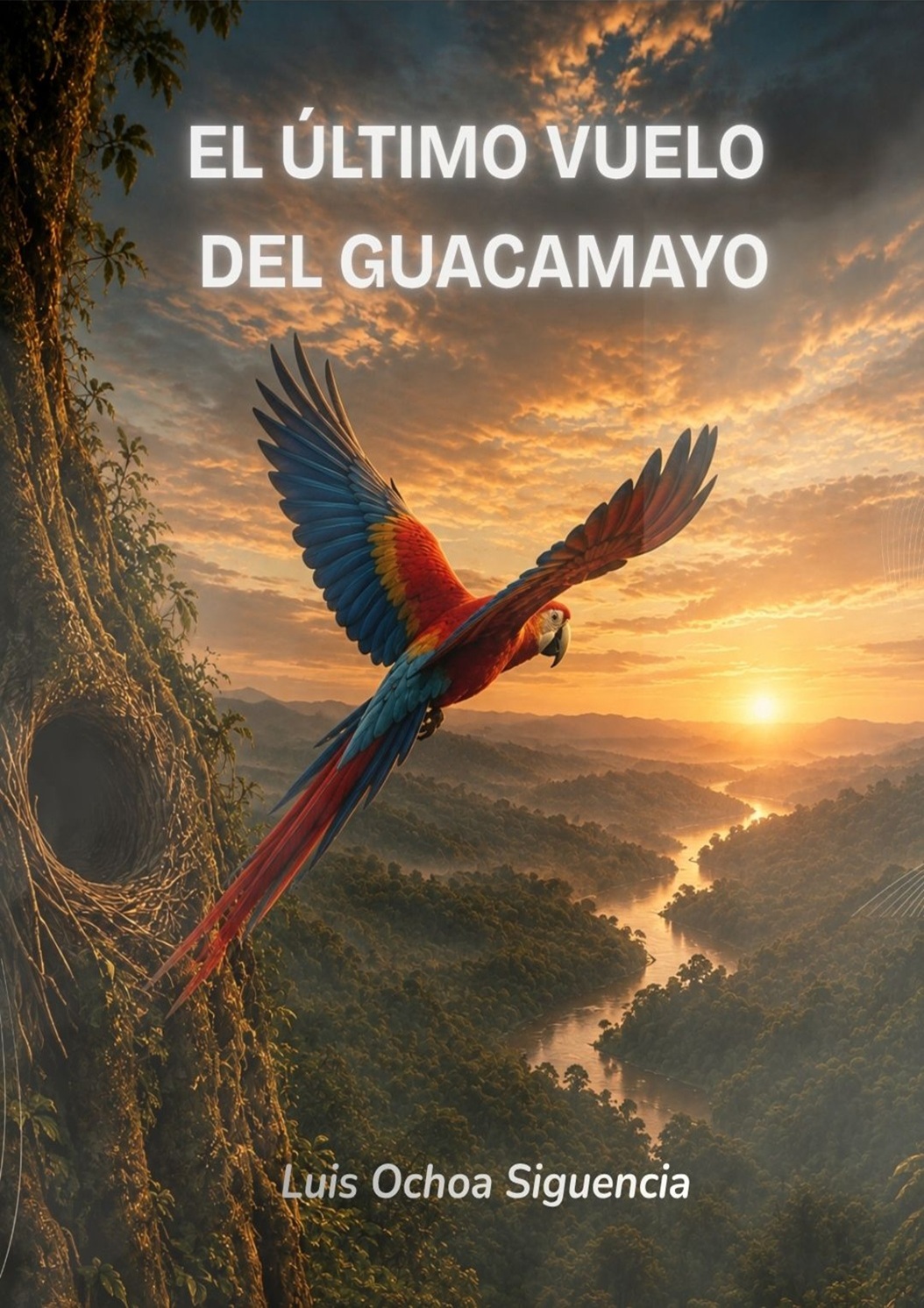
El último vuelo del guacamayo
Behind the Novel
LITERARY FICTION • SYMBOLIC FABLE • FAMILY & GENERATIONS
A symbolic literary journey through family, memory and freedom, El último vuelo del guacamayo explores what happens when those we love leave to follow their own paths—and what remains of us across generations.
Author: Luis Ochoa Siguencia
Publication: 2026
Genre: Literary Fiction / Symbolic Fable
Setting: The natural world
Availability: Open Access
Licence: CC BY-NC-SA 4.0
Why this Story Was Written
Some departures change a life. Others change the lives of those who remain.
El último vuelo del guacamayo was written as a literary reflection on one of the most universal experiences of human life: learning to let go. Through the life of a macaw and the different paths taken by its children, the story explores what happens when those we love leave the place where their journey began.
Luis Ochoa Siguencia conceived the work as part of his wider symbolic literary project, where nature and narrative become spaces for philosophical reflection. The macaw's flight is not simply a movement through the sky. It becomes a metaphor for freedom, transformation, departure and the search for a path of one's own.
The story also reflects on the relationship between generations. What parents give to their children cannot determine the paths they will take. It can only provide something from which those children begin to construct lives of their own.
Rather than offering a simple moral, the novel invites readers to consider what we inherit, what we transform and what remains when people, places and generations change.
The Human Landscape Behind the Novel
Leaving Home
Leaving is one of the central experiences of the story.
The first flight represents discovery, but later flights acquire different meanings. Leaving home can mean growing, searching, choosing, or simply following a direction that cannot yet be understood.
The novel treats departure not as a rejection of one's origins, but as part of becoming oneself.
Family and Generations
At the heart of the story is a family whose members gradually follow different paths.
The children do not repeat the lives of their parents. Each discovers a different relationship with distance, home and belonging.
Across generations, the story asks what can truly be inherited. A place can be inherited, but so can a memory, a way of seeing, a story or a sense of where one's journey began.
A Literary Reflection Rather Than a Moral Tale
Although the novel is structured as a symbolic fable, El último vuelo del guacamayo is not intended to deliver a single fixed lesson.
Its ideas emerge through the natural world, family relationships, recurring images and the passage of time rather than through direct philosophical argument.
Readers are invited to interpret the meaning of the flight, the tree, the river and the return according to their own experiences.
The Meaning of Flight
Beyond Freedom
Flight is often associated with freedom.
In the novel, however, freedom also carries responsibility. To fly away is to leave something behind, but it is also to discover what can be carried forward.
The story therefore presents freedom not simply as escape, but as the courage to follow a path that belongs to oneself.
Leaving and Returning
Departure and return form a recurring movement throughout the narrative.
Yet returning does not mean recovering the past unchanged.
Those who leave are transformed by their journeys, and the places to which they return have changed as well. Return therefore becomes an encounter between memory and the present.
Symbols Throughout the Novel
The Tree
The tree represents origin, home and memory.
It is the place where the story begins and a point of reference throughout the lives of several generations.
Although those who grow beneath its branches eventually leave, the tree remains connected to the stories they carry with them.
The Flight
Flight is the central symbol of the novel.
It represents discovery, freedom, departure, transformation and the search for one's own direction.
As the story progresses, its meaning changes. The first flight belongs to childhood; later flights belong to adulthood, separation and the continuation of life.
The River
The river represents movement and continuity.
It is always changing while remaining part of the same landscape, much like the generations that pass through the story.
The river suggests that life continues beyond individual journeys.
The Forest
The forest represents the wider world beyond the familiar.
It contains places that are known and unknown, paths that can be followed and others that disappear beyond sight.
For the characters, the forest becomes a space of discovery, uncertainty and possibility.
Memory
Memory connects places and generations.
The characters may leave the physical landscape where their lives began, but memories of that place continue to influence how they understand themselves.
Memory therefore becomes a form of continuity rather than a return to the past.
Themes Explored
Belonging
The novel asks whether belonging depends on remaining in one place.
Its characters gradually discover that a sense of home can travel with them.
Identity
Identity develops through movement, relationships and experience.
The children inherit something from their parents, but they transform that inheritance into lives of their own.
Loss
Loss appears naturally as part of the passage of time.
The story does not treat loss simply as an ending, but as part of the process through which memory and continuity are created.
Legacy
What remains after a life is not always something tangible.
A story, a memory, a way of seeing the world or something learned from another person can continue across generations.
The Search for Meaning
El último vuelo del guacamayo does not ask readers to find one definitive interpretation.
Instead, it invites reflection on a series of questions: What does it mean to belong somewhere? When should we leave? What does it mean to return? How much of our origins remains within us after we have travelled far from them?
Ultimately, the novel suggests that a life can continue through the people, memories and stories that remain after the individual journey has changed direction.
Educational and Reflective Value
Literature for Reflection
El último vuelo del guacamayo offers opportunities for discussion in literary, educational and reflective contexts.
Teachers, students, book clubs and reading groups may use the novel to explore themes including:
- family and intergenerational relationships
- identity and belonging
- freedom and personal choice
- departure and return
- memory and legacy
- nature and symbolic literature
- loss and continuity
- the meaning of home
- generational change
- philosophical reflection through fiction
Rather than presenting fixed conclusions, the novel encourages interpretative dialogue and invites readers to connect its symbolic journey with their own experiences.
Reading Experience
Readers approaching El último vuelo del guacamayo should expect a quiet and contemplative literary experience.
The novel unfolds across the lives of several generations, allowing its themes to develop gradually through recurring images of trees, rivers, forests and flight.
Its narrative rhythm favours observation and emotional resonance rather than dramatic action, inviting readers to pause and reflect on the meaning behind apparently simple events.
Those interested in symbolic fiction, literary fables, contemporary literature, family narratives and philosophical storytelling may discover a work that invites reflection long after the final page.
Rather than explaining everything, the novel leaves space for the reader to decide what the final flight means.
About the Author
Luis Ochoa Siguencia is a contemporary author whose symbolic literary works explore memory, identity, human relationships and the search for meaning through fiction. His literary project combines poetic narrative, philosophical reflection and universal human experiences.
Across his works, nature, cultural memory and symbolic storytelling become spaces through which readers are invited to reflect on questions of identity, belonging, knowledge, responsibility and the passage of time.
Related Works
Readers interested in El último vuelo del guacamayo may also appreciate other symbolic and reflective works by Luis Ochoa Siguencia.
Aprender caminando explores learning as a gradual journey of observation and self-discovery.
YACHAY AMARU: La serpiente del conocimiento explores knowledge, memory, ancestral wisdom and the relationship between human beings, nature and community through symbolic fiction inspired by the Cañari worldview.
Aman-Yupanqui, El Niño del Pacto reflects upon responsibility, cultural memory and inheritance through symbolic fiction rooted in the Andean world.
Carachula: The Lost Civilization of the Cañaris offers a broader meditation on memory, history and identity through the landscapes of southern Ecuador.
Together, these works form an interconnected literary universe in which different stories approach different dimensions of human experience. Rather than sharing characters or chronological continuity, they are united by a common commitment to symbolic fiction, reflective reading and the enduring search for meaning.