
Aman-Yupanqui, the Boy of the Covenant
Behind the Novel
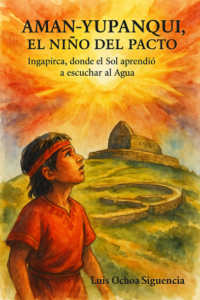
SYMBOLIC FABLE • ANDES • INGAPIRCA
Inspired by the archaeological landscapes of Ingapirca and the living traditions of the Ecuadorian Andes, Aman-Yupanqui, the Boy of the Covenant explores memory, identity, cultural continuity and humanity’s enduring relationship with place through symbolic fiction.
Author: Luis Ochoa Siguencia
Publication: 2025
Genre: Symbolic Fable
Setting: Ingapirca • Andes • Ecuador
Availability: Open Access
Licence: CC BY-NC-SA 4.0
Why this Story Was Written
Some stories emerge from imagination; others grow from a landscape that continues to speak through memory. Aman-Yupanqui, El Niño del Pacto belongs to the latter tradition. Rather than recreating a specific historical event, the novel explores the enduring relationship between people, landscape and inherited responsibility within the Andean world of southern Ecuador.
Luis Ochoa Siguencia conceived this work as part of a broader literary project dedicated to symbolic fiction inspired by the cultural heritage of the Andes and the Amazon. The novel does not seek to reconstruct the past as archaeology or historiography would do. Instead, it asks a different question: how do communities remember values that cannot be preserved in museums or monuments?
Across generations, Andean communities have transmitted knowledge through stories, rituals, journeys, and everyday practices. Such knowledge survives not because it is written down, but because it is continually lived. This understanding forms the intellectual and emotional foundation of the novel.
The story therefore becomes less about a particular child than about the universal experience of discovering that identity is not inherited automatically. It is cultivated through memory, responsibility and the willingness to recognise one’s place within a much larger human and natural community.
The Andean World that Inspired the Novel
Landscape as a Living Presence
The Andes are more than a geographical setting. Throughout Andean mythology and oral tradition, mountains, rivers, forests and skies participate in human life. They are not passive scenery but active companions in the long dialogue between humanity and nature.
This worldview differs fundamentally from many modern perspectives that separate culture from the natural environment. Within traditional Andean thought, people belong to the landscape rather than possessing it. Human existence is understood as one element within a larger network of reciprocal relationships.
The mountains overlooking southern Ecuador have witnessed centuries of migration, agriculture, ceremony and cultural transformation. Ancient pathways, sacred lakes and archaeological sites continue to inspire stories that connect present generations with ancestral memory.
Aman-Yupanqui draws inspiration from this cultural landscape without attempting to reproduce specific legends. Instead, it recreates the atmosphere through which oral tradition has always travelled: conversations between generations, shared journeys, careful observation of nature and respect for places that carry historical meaning.
Oral Tradition and Cultural Memory
Before history was written, it was remembered.
For centuries, stories passed from grandparents to children preserved ethical principles, collective experiences and practical knowledge. These narratives taught listeners how to live rather than merely what had happened.
The novel honours this tradition by embracing a narrative rhythm inspired by spoken storytelling. Reflection, silence and symbolic images occupy an important place because they resemble the pace through which oral cultures encourage attentive listening.
Rather than presenting cultural heritage as something distant or nostalgic, the novel suggests that memory remains active whenever communities continue to share stories capable of shaping future generations.
In this sense, literature becomes another form of cultural continuity.
The Meaning of the Pact
Promise Beyond Obligation
Throughout many cultural traditions, a promise represents more than an agreement between individuals. Within the symbolic universe of the Andes, a pact often expresses a relationship of reciprocity involving family, community, ancestors and the natural world.
A promise establishes responsibility.
It acknowledges that every action influences relationships extending beyond the individual.
The title of the novel therefore carries symbolic significance without requiring a literal interpretation. The pact invites reflection upon questions that remain relevant across cultures:
- What responsibilities do we inherit?
- What should be preserved?
- What deserves to be remembered?
- How do we honour those who came before us?
Rather than offering definitive answers, the novel encourages readers to consider these questions within their own cultural experiences.
Reciprocity as an Ethical Principle
One of the central values underlying Andean civilisation is reciprocity.
Communities traditionally survived through cooperation, mutual support and collective responsibility. Agricultural work, celebrations and ceremonies often depended upon shared participation rather than individual achievement.
This ethical perspective continues to resonate in contemporary discussions surrounding environmental stewardship, social cohesion and intercultural understanding.
The symbolic pact therefore represents not restriction but belonging.
Symbols Throughout the Novel
Mountains
Throughout Andean mythology, mountains often represent permanence, wisdom and continuity.
They witness generations without belonging to any single generation.
Within symbolic fiction, mountains frequently remind readers that genuine understanding requires patience rather than conquest.
Rivers
Rivers symbolise movement, transformation and renewal.
Water connects places, carries memory and reminds us that change does not necessarily erase identity. Instead, identity evolves while remaining connected to its source.
Children
Children occupy a unique symbolic position because they stand between inheritance and possibility.
They receive cultural memory while simultaneously becoming those responsible for carrying it into the future.
This dual role gives childhood a profound ethical dimension throughout the novel.
Journeys
Travelling has long functioned as one of literature’s oldest metaphors for learning.
In the Andean tradition, walking represents observation, humility and gradual understanding.
The destination matters less than the transformation produced along the path.
Silence
Silence in the novel never signifies emptiness.
Instead, it represents attentive presence.
Many traditional societies value listening before speaking, recognising that understanding often develops through observation rather than immediate explanation.
Silence therefore becomes another language.
Memory
Memory extends beyond personal recollection.
It becomes cultural memory—the shared inheritance through which communities preserve identity across generations.
The novel repeatedly suggests that forgetting is not merely the loss of information but the gradual disappearance of relationships that once connected people with place, history and one another.
Light
Light symbolises recognition rather than certainty.
Moments of illumination do not necessarily resolve every question; they allow readers to perceive familiar realities from new perspectives.
Knowledge therefore appears gradually rather than through sudden revelation.
Ancestral Knowledge
The novel approaches indigenous knowledge with respect rather than romanticisation.
Traditional wisdom emerges through accumulated observation of landscapes, seasons, communities and relationships developed over centuries.
Such knowledge complements rather than opposes contemporary understanding, inviting dialogue between different ways of interpreting the world.
Educational Value
Literature for Reflection
Aman-Yupanqui has been written as symbolic educational literature capable of supporting classroom discussion across different age groups.
Rather than teaching historical facts directly, it encourages reflective learning through narrative.
Teachers may use the novel to introduce conversations about:
- Andean cultural heritage
- Indigenous knowledge systems
- Ethics and personal responsibility
- Cultural identity
- Oral tradition
- Environmental awareness
- Community cooperation
- Intercultural dialogue
- Symbolism in literature
- Respect for cultural diversity
Parents may equally find opportunities to discuss family history, shared values and the importance of listening to older generations.
Students can explore how fiction encourages critical thinking by presenting moral questions without imposing simple solutions.
For this reason, the novel functions simultaneously as literary fiction and as a resource for intercultural education.
Reading Experience
Readers approaching Aman-Yupanqui should not expect an adventure driven primarily by action.
Instead, the novel offers a contemplative reading experience rooted in atmosphere, symbolism and gradual discovery.
Its narrative invites slow reading.
Moments of reflection frequently carry greater importance than dramatic events, allowing readers to engage emotionally as well as intellectually.
Those interested in Andean mythology, cultural memory, symbolic fiction and educational literature may discover themes extending far beyond the geographical setting.
Although inspired by Ecuador and the cultural traditions of the southern Andes, the questions explored throughout the novel remain universal.
What deserves to be remembered?
How do we inherit responsibility?
How does cultural identity continue to evolve without losing its roots?
Each reader may arrive at different answers.
About the Author
Luis Ochoa Siguencia is a contemporary author whose literary work explores the meeting point between symbolic fiction, intercultural literature and cultural heritage. His narratives draw inspiration from the Andes and the Amazon while addressing universal questions concerning memory, identity, ethics and humanity’s relationship with the natural world.
Rather than recreating historical events, his fiction transforms landscapes, oral traditions and symbolic imagery into narratives that invite contemplation, dialogue and educational reflection. Together, his works form an interconnected literary project dedicated to preserving cultural memory through imaginative storytelling accessible to readers of different ages and cultural backgrounds.
Related Works
Readers interested in the symbolic universe of Aman-Yupanqui may also appreciate other works within the same literary collection.
- Aprender caminando explores learning as a gradual process of observation and self-discovery, emphasising that genuine understanding often begins with the way we perceive others and ourselves.
- El pacto de la laguna reflects upon community, memory and shared responsibility through an Andean symbolic narrative centred on cooperation and belonging.
- La joya del Inti examines themes of balance, heritage and the relationship between humanity and the natural world, drawing inspiration from the cultural landscapes of the Ecuadorian Andes.
- Those wishing to explore a broader historical imagination rooted in Cañari culture may continue with Carachula: The Lost Civilization of the Cañaris, a novel inspired by archaeological landscapes, oral tradition and the enduring dialogue between history and legend.
Together, these works do not form a conventional series. Rather, they constitute an evolving literary universe in which each book examines a different dimension of memory, identity, symbolic heritage and the enduring relationship between people and the landscapes that shape them.