
Aprender caminando
Behind the Story
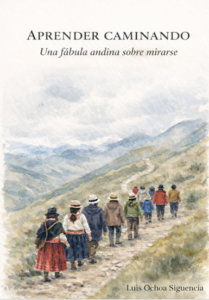
REFLECTIVE FABLE • ANDES • LEARNING
Inspired by the cultural landscapes of the Ecuadorian Andes, Aprender caminando explores learning, observation, self-discovery and the gradual transformation of perception through symbolic storytelling.
Author: Luis Ochoa Siguencia
Publication: 2026
Genre: Reflective Fable
Setting: Andes • Ecuador
Availability: Open Access
Licence: CC BY-NC-SA 4.0
Why this Story Was Written
Some lessons cannot be taught in a classroom. They emerge slowly through observation, experience and the willingness to see the world from another perspective. Aprender caminando (Learning by Walking) was written from this conviction.
Inspired by the cultural landscapes of the southern Ecuadorian Andes, the book explores learning not as the accumulation of information, but as a gradual transformation of perception. Rather than presenting knowledge as something that can simply be transmitted, the story suggests that genuine understanding develops while moving through life with curiosity, humility and openness.
Luis Ochoa Siguencia wrote this symbolic fable as part of his wider literary project dedicated to preserving cultural memory through fiction inspired by Andean worldviews. Like many traditional stories shared across generations, the narrative does not aim to provide definitive answers. Instead, it invites readers to ask better questions.
The title itself reflects a philosophy deeply rooted in Andean culture: people learn not only by studying, but by walking, observing, listening and participating in the life of their community.
The Andean World that Inspired the Story
Walking as a Way of Knowing
Across the Andes, paths have always been more than routes connecting villages. Ancient trails linked communities, sacred places, agricultural terraces and ceremonial centres, while also carrying stories, traditions and shared memories across generations.
Walking has therefore become a powerful cultural metaphor.
Each journey represents an opportunity to observe nature, understand relationships and recognise one’s place within a larger living landscape.
In this worldview, movement is never purely physical.
Every step becomes an act of learning.
Rather than separating education from everyday life, Andean culture traditionally integrates learning into work, family relationships, community celebrations and encounters with nature.
Aprender caminando draws inspiration from this educational philosophy without attempting to recreate any single historical tradition. Instead, it transforms these cultural values into a symbolic narrative accessible to contemporary readers around the world.
Oral Tradition and Everyday Wisdom
For centuries, Andean communities preserved knowledge through oral tradition.
Grandparents, parents and community elders shared stories while walking mountain paths, tending crops, caring for animals or gathering around the evening fire.
These stories rarely offered direct instruction.
Instead, they encouraged reflection.
Children were invited to observe carefully, to compare experiences and to discover meaning for themselves.
The novel follows this same literary tradition.
Its quiet rhythm reflects the pace of conversation rather than lecture, allowing readers to participate actively in the process of interpretation.
The result is a story that honours the educational value of oral storytelling while speaking to modern audiences interested in symbolic fiction, intercultural literature and lifelong learning.
The Symbolism of Walking
Learning Beyond the Destination
Modern society often celebrates speed, efficiency and measurable achievement.
The symbolic world of Aprender caminando proposes a different perspective.
Walking represents the acceptance that understanding develops gradually.
Each step contributes something valuable, even when the destination remains unknown.
The journey therefore becomes more significant than arrival itself.
This idea resonates strongly with traditional Andean concepts of patience, observation and personal growth.
Knowledge is not acquired all at once.
It matures through experience.
Looking Differently
One of the central themes running throughout the story is perception.
The book suggests that many misunderstandings arise not because reality changes, but because we observe it from only one point of view.
Changing perspective often transforms the meaning of what we see.
This symbolic idea extends beyond the landscape into relationships with other people, different cultures and even ourselves.
Learning begins when certainty gives way to curiosity.
Symbols Throughout the Story
The Path
The path symbolises both education and life itself.
Rather than leading simply from one location to another, it represents continuous personal development.
Every traveller encounters different experiences because each person walks with different memories, expectations and questions.
Mountains
The mountains stand as symbols of continuity and perspective.
They remind readers that genuine understanding requires time and patience.
Their apparent permanence contrasts with the changing experiences of those who travel through them.
Children
Children represent openness rather than innocence alone.
Their willingness to question accepted assumptions allows genuine learning to take place.
Within symbolic literature, childhood often becomes a metaphor for intellectual curiosity.
The Journey
Journeys symbolise transformation.
Readers are reminded that meaningful change rarely occurs through dramatic events.
Instead, it develops quietly through countless small experiences accumulated over time.
Silence
Silence occupies a central place in the story.
Rather than indicating absence, silence becomes the space where observation, reflection and understanding emerge.
Many traditional cultures recognise silence as an essential companion to wisdom.
The narrative embraces this idea by allowing moments of contemplation to carry as much significance as dialogue.
Memory
Memory functions as a bridge between generations.
The story suggests that communities remain alive through the experiences they choose to remember and share.
Personal identity therefore grows from collective memory rather than isolated individual experience.
Nature
Nature is presented neither as decoration nor as an obstacle.
Instead, it becomes an active participant in the educational journey.
Mountains, rivers, plants and changing weather encourage readers to recognise the interconnectedness of human life and the environment.
Educational Value
A Story for Schools and Families
Although written as literary fiction, Aprender caminando offers significant educational opportunities across different learning environments.
Teachers may use the book to encourage discussion about:
- cultural heritage
- ethical decision-making
- observation and critical thinking
- intercultural dialogue
- environmental awareness
- symbolic interpretation
- emotional intelligence
- community values
- lifelong learning
- indigenous knowledge
Parents can use the story to begin conversations about empathy, patience, respect for diversity and the importance of listening before judging.
Students may discover how literature develops interpretative thinking by presenting complex ideas through accessible symbolic narratives.
Rather than providing moral lessons directly, the story encourages readers to construct their own understanding through reflection.
Reading Experience
Readers approaching Aprender caminando should expect a contemplative rather than action-driven narrative.
Its strength lies in atmosphere, symbolism and emotional resonance rather than dramatic events.
The story rewards attentive reading.
Each encounter, landscape and conversation gradually contributes to a deeper understanding of the questions explored throughout the narrative.
Those interested in Andean mythology, educational literature, symbolic fiction and intercultural storytelling will recognise a literary tradition that values reflection as much as action.
Although rooted in the cultural landscapes of Ecuador, the themes explored remain universally relevant.
How do we learn?
Why do different people see the same world differently?
Can understanding begin simply by slowing down and paying attention?
These questions extend far beyond the pages of the book.
About the Author
Luis Ochoa Siguencia is a contemporary author whose symbolic fiction explores the relationship between cultural memory, education and identity. Drawing inspiration from the Andes and the Amazon, his literary project seeks to preserve intangible heritage through stories that combine poetic narrative with philosophical reflection.
His works are designed not only to entertain but also to encourage dialogue between cultures, generations and different ways of understanding the world. Through symbolic literature, he invites readers to rediscover values rooted in observation, reciprocity, respect for nature and the enduring wisdom of oral tradition.
Related Works
Readers who appreciate Aprender caminando may also enjoy other titles from the same symbolic literary universe.
- Aman-Yupanqui, El Niño del Pacto explores responsibility, cultural inheritance and the relationship between identity and ancestral memory through an Andean symbolic narrative.
- El pacto de la laguna examines community, reciprocity and the shared responsibility of preserving cultural memory within landscapes shaped by both nature and tradition.
- La joya del Inti reflects upon balance, environmental ethics and the symbolic relationship between human beings and the natural world, drawing inspiration from the cultural heritage of the Ecuadorian Andes.
- For readers interested in a broader historical imagination inspired by Cañari civilisation, Carachula: The Lost Civilisation of the Cañaris expands these themes through a larger narrative exploring archaeology, oral tradition and the enduring dialogue between history and legend.
Together, these books form an interconnected literary project in which each work approaches a different dimension of learning, memory, identity and humanity’s relationship with landscape. They are linked not by continuing characters, but by a shared commitment to preserving cultural heritage through timeless symbolic fiction.