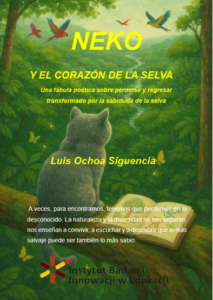
Neko and the Heart of the Forest
Behind the Story
SYMBOLIC FABLE • ECUADORIAN AMAZON • SHUAR HERITAGE
Neko and the Heart of the Forest is a symbolic fable inspired by the Ecuadorian Amazon and the Shuar worldview. Through friendship, curiosity and the living forest, it invites readers of all ages to rediscover respect for nature, cultural diversity and the wisdom of attentive listening.
Author: Luis Ochoa Siguencia
Publication: 2025
Genre: Symbolic Fable
Setting: Ecuadorian Amazon
Availability: Open Access
Licence: CC BY-NC-SA 4.0
Why this Story Was Written
Some stories entertain. Others awaken a different way of seeing the world.
Neko and the Heart of the Forest was written as a symbolic fable about childhood, friendship and humanity’s relationship with the living world. Rather than presenting nature as a distant landscape or a setting for adventure, the novel invites readers to discover the forest as a place of learning, wonder and quiet transformation.
Luis Ochoa Siguencia conceived this story as the beginning of a broader literary universe inspired by the Ecuadorian Amazon and the values that have shaped the relationship between Indigenous communities and the rainforest for centuries. The novel does not retell traditional myths. Instead, it creates an original symbolic narrative that honours the wisdom, respect for life and sense of interconnectedness found within the Shuar worldview while remaining accessible to readers from every culture.
At its heart, Neko and the Heart of the Forest asks a timeless question:
Can we truly understand nature if we learn only to observe it, but never to listen to it?
Rather than offering simple answers, the story encourages children and adults alike to rediscover curiosity, empathy and the quiet wisdom that emerges when we recognise ourselves as part of the living world.
The Amazon Rainforest that Inspired the Story
The Forest as a Living Community
The Ecuadorian Amazon is one of the most biologically diverse regions on Earth. Its rivers, towering trees, countless plant species and extraordinary wildlife create ecosystems where every form of life depends upon countless others.
This living richness inspired the world of Neko.
Within the novel, the forest is never merely a backdrop.
It breathes.
It remembers.
It teaches.
Every path, every stream and every tree participates in an invisible dialogue that encourages readers to look beyond appearances and recognise the profound relationships sustaining life.
This understanding reflects a worldview shared by many Indigenous cultures of the Amazon, where nature is approached not as property but as a living community deserving respect.
A Literary Tribute to the Shuar Worldview
Neko and the Heart of the Forest is an original literary creation inspired by the ethical and spiritual values associated with the Shuar people of the Ecuadorian Amazon.
It is not a retelling of Shuar oral tradition, nor does it claim to represent Indigenous beliefs in a documentary sense.
Instead, the novel respectfully draws inspiration from ideas that continue to shape Amazonian ways of understanding the world: harmony with nature, attentive listening, reciprocity, courage and the recognition that every living being has intrinsic value.
Through symbolic fiction, these principles become accessible to readers of all ages without reducing their cultural richness or complexity.
The Meaning of the Heart of the Forest
More Than a Place
The heart of the forest is not simply a geographical location.
It represents the invisible centre of life itself.
It is the place where relationships become visible, where every living being contributes to the balance of the whole and where genuine understanding begins with humility rather than certainty.
The novel suggests that finding the heart of the forest is not a matter of travelling farther into nature.
It is a matter of learning to perceive differently.
Only those willing to listen, observe and respect the living world can truly recognise its hidden wisdom.
Childhood as Discovery
The choice of a child as the central figure is deeply symbolic.
Children approach the world with curiosity rather than certainty.
They ask questions adults often forget to ask.
Throughout the novel, childhood represents openness, imagination and the capacity to form authentic relationships with both people and nature.
Learning therefore becomes an adventure of perception rather than the accumulation of facts.
Symbols Throughout the Story
The Forest
The forest symbolises life in its fullest expression.
Every tree, river, animal and sound contributes to an intricate web of relationships.
The story reminds readers that no living being exists in isolation.
The health of one depends upon the wellbeing of all.
Neko
Neko represents curiosity.
Rather than symbolising innocence alone, the character embodies the willingness to learn through observation, empathy and experience.
His journey reflects the universal process of growing by learning to see beyond first impressions.
Animals
The animals encountered throughout the story symbolise different forms of wisdom.
Rather than serving merely as companions, they reveal that every living creature possesses its own place within the balance of the forest.
Their presence encourages respect for biodiversity and the value of coexistence.
Rivers
The rivers symbolise movement and continuity.
They connect distant places while sustaining life throughout the forest.
Like memory, rivers continually change while remaining connected to their source.
Light
Light represents understanding.
Rather than eliminating mystery, it gradually reveals relationships previously hidden from view.
Knowledge therefore appears as a process of discovery rather than immediate certainty.
Silence
Silence occupies a central place within the novel.
The forest teaches quietly.
Those who listen carefully begin to perceive meanings that cannot be expressed through words alone.
The story presents silence not as emptiness but as another language through which nature communicates.
The Heart
The heart symbolises connection.
It reminds readers that genuine understanding depends not only upon knowledge but also upon compassion, empathy and respect for all forms of life.
The title itself invites reflection on the emotional as well as ecological dimensions of the story.
Themes Explored
Friendship
Friendship develops throughout the novel as an expression of trust, respect and shared discovery.
Rather than depending upon similarity, genuine friendship grows through openness to difference and mutual care.
Environmental Responsibility
The novel encourages readers to recognise that humanity forms part of nature rather than standing apart from it.
Environmental stewardship emerges naturally through affection for the living world rather than through fear or obligation.
The story suggests that people protect what they first learn to love.
Curiosity
Curiosity is celebrated as one of childhood’s greatest strengths.
Every meaningful discovery begins with the courage to ask questions and to observe without prejudice.
The novel encourages readers to remain lifelong learners.
Interconnectedness
One of the story’s central ideas is that all living beings exist within a network of relationships.
Plants, animals, rivers and people depend upon one another in countless visible and invisible ways.
Recognising these connections becomes the foundation of both ecological awareness and ethical responsibility.
Educational Value
Literature that Inspires Environmental Awareness
Neko and the Heart of the Forest offers rich opportunities for learning in schools, libraries and family reading programmes.
Teachers and parents may use the story to explore:
- biodiversity
- Amazon rainforest ecosystems
- environmental stewardship
- symbolic literature
- Indigenous knowledge
- emotional intelligence
- friendship
- empathy
- ecological responsibility
- intercultural dialogue
- critical thinking
- respect for cultural diversity
The novel also encourages interdisciplinary learning, connecting literature with environmental education, ethics, geography and cultural studies.
Rather than presenting ecological concepts through factual explanation alone, it invites readers to develop an emotional relationship with nature through imagination.
Reading Experience
Readers approaching Neko and the Heart of the Forest will discover a gentle and contemplative adventure where discovery unfolds through observation rather than conflict.
Its poetic language, symbolic imagery and carefully crafted atmosphere encourage slow reading and thoughtful reflection.
Children may enjoy the wonder of exploring an enchanted forest filled with life and mystery.
Adult readers may recognise deeper reflections upon identity, ecological responsibility and humanity’s enduring relationship with the natural world.
Although inspired by the Ecuadorian Amazon, the novel speaks to readers everywhere.
It reminds us that every forest possesses a heart, every landscape tells stories and every child carries the capacity to rediscover a world too often overlooked by adults.
About the Author
Luis Ochoa Siguencia is a contemporary author whose literary work explores symbolic fiction, cultural memory and humanity’s relationship with nature. Drawing inspiration from both the Andes and the Amazon, he creates stories that transform landscapes, oral traditions and philosophical reflection into narratives that encourage empathy, intercultural dialogue and environmental awareness.
His literary project seeks to preserve intangible heritage while inspiring readers of all ages to approach the world with curiosity, responsibility and imagination.
Related Works
Readers who enjoy Neko and the Heart of the Forest may also appreciate other symbolic works by Luis Ochoa Siguencia.
Kuntur: Guardian of the Heart of the Forest continues the literary universe introduced in Neko, exploring the quiet wisdom of guidance, responsibility and ecological stewardship through a poetic story inspired by the values of the Shuar worldview.
The Honey of the Four Winds reflects upon cooperation, biodiversity and humanity’s dependence upon the smallest forms of life, celebrating bees as symbols of resilience, community and hope.
Aprender caminando explores learning as a lifelong journey shaped by observation, curiosity and openness, complementing Neko‘s educational vision through an Andean symbolic perspective.
Readers interested in the cultural landscapes of the Andes may also discover Aman-Yupanqui, El Niño del Pacto, where memory, identity and ancestral responsibility become central themes within another branch of the author’s symbolic literary universe.
Together, these works form an interconnected collection inspired by Ecuador’s extraordinary natural and cultural heritage. Although each story stands independently, all invite readers to rediscover the values of empathy, respect, imagination and the enduring dialogue between humanity and the living world.