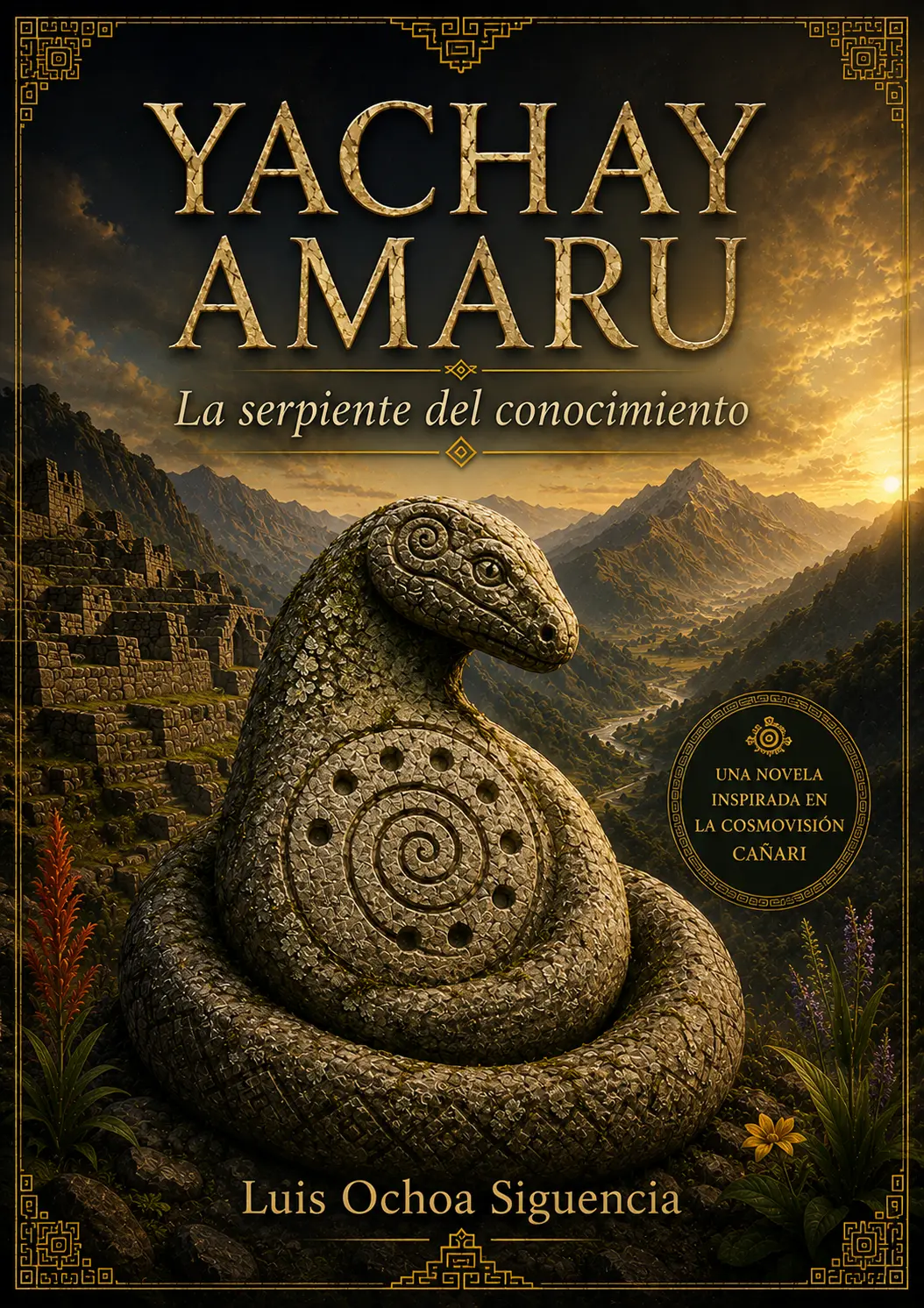
YACHAY AMARU: La serpiente del conocimiento
Behind the Novel
PHILOSOPHICAL NOVEL • CAÑARI WORLDVIEW • INDIGENOUS KNOWLEDGE
Inspired by the Cañari worldview and the symbolic traditions of the Ecuadorian Andes, YACHAY AMARU: La serpiente del conocimiento blends philosophical fiction, Indigenous knowledge and symbolic storytelling to explore wisdom, memory and the enduring relationship between humanity and nature.
Author: Luis Ochoa Siguencia
Publication: 2026
Genre: Philosophical Novel
Setting: Ecuadorian Andes • Cañari Worldview • Ecuador
Availability: Open Access
Licence: CC BY-NC-SA 4.0
Why this Story Was Written
Some journeys begin by searching for answers. Others begin by learning to ask better questions. YACHAY AMARU: La serpiente del conocimiento was written to explore one of humanity's oldest questions: how does wisdom truly emerge?
Inspired by the Cañari worldview and the symbolic traditions of the Ecuadorian Andes, the novel does not attempt to explain Indigenous philosophy through academic discourse alone. Instead, it transforms ancestral knowledge, oral tradition and the natural world into literary fiction that invites readers to experience wisdom through story.
Rather than offering certainty, the novel encourages reflection, dialogue and attentive observation, suggesting that knowledge is cultivated throughout life rather than simply acquired.
The Worldview that Inspired the Novel
Beyond Knowledge
Across the Andes, knowledge has traditionally been understood as something lived before it is explained. Rivers, mountains, stones, seeds and silence have long formed part of Indigenous ways of learning, where education extends beyond formal instruction and becomes inseparable from everyday life.
YACHAY AMARU draws inspiration from this philosophical tradition. Although entirely a work of fiction, the novel reflects the symbolic worldview associated with the Cañari people of southern Ecuador, exploring how memory, experience and observation shape human understanding.
Rather than presenting the past as something to recover, the story asks how wisdom continues to live in the present.
Between Philosophy and Story
When Symbols Become Teachers
Unlike conventional philosophical texts, YACHAY AMARU explores ideas through narrative rather than argument.
The serpent, the spiral, the stone and the river are not simply literary images. They become guides that accompany Tacuri Tenesaca as he gradually discovers that every answer leads to another question.
The novel suggests that philosophy is not confined to books. It can also emerge through silence, landscape, memory and lived experience.
Symbols Throughout the Novel
Amaru — The Serpent
Across the Andes, the serpent symbolises transformation, continuity and the movement between different dimensions of existence. In the novel, Amaru represents wisdom that continually grows through experience.
The Spiral
The spiral symbolises learning without end. Every return reveals new understanding, reminding readers that genuine knowledge is never complete.
The Stone
The ancient stone preserves memory across generations. It reminds us that some forms of knowledge are not inherited through instruction but discovered through patient observation.
Seeds
Seeds represent potential waiting to unfold. Their growth reflects the gradual development of wisdom, understanding and personal transformation.
The River
The river symbolises permanence within change. Although every drop moves onward, the river remains, reflecting one of the novel's central philosophical ideas about memory and identity.
Themes Explored
Wisdom
The novel presents wisdom not as accumulated information but as a lifelong process shaped by observation, humility and lived experience.
Indigenous Knowledge
Inspired by the Cañari worldview, the story celebrates ancestral ways of knowing while recognising their continuing relevance in contemporary society.
Cultural Memory
Memory is portrayed as a living relationship between generations, landscapes and shared experience rather than a simple record of the past.
Education
The novel offers a philosophical reflection on learning itself, suggesting that education begins with curiosity and grows through attentive living.
Humanity and Nature
Mountains, rivers and forests are never passive settings. They become participants in the search for meaning, reflecting an Andean understanding of the relationship between people and the living world.
Educational Value
YACHAY AMARU offers opportunities for discussion across literature, philosophy, Indigenous studies, intercultural education and environmental humanities.
The novel may support conversations about:
- Cañari worldview
- Indigenous knowledge systems
- Andean philosophy
- Cultural memory
- Symbolic literature
- Philosophy of education
- Ecuadorian literature
- Latin American literature
- Intercultural dialogue
- Environmental ethics
Rather than functioning as a philosophical treatise, the novel demonstrates how literature can inspire reflection on knowledge, identity and humanity's relationship with nature.
Reading Experience
Readers should approach YACHAY AMARU not only as a novel but also as a philosophical journey.
Inspired by the landscapes and cultural memory of the Ecuadorian Andes, the story unfolds through symbols, dialogue and quiet moments of discovery rather than dramatic action alone. Its questions extend beyond one culture, inviting readers everywhere to reflect on wisdom, education, memory and the enduring relationship between human beings and the natural world.
About the Author
Luis Ochoa Siguencia is a contemporary author whose literary work brings together symbolic fiction, philosophical literature and intercultural storytelling. Inspired by the Andes and the Amazon, his narratives transform landscapes, oral traditions and Indigenous worldviews into stories that encourage reflection, dialogue and lifelong learning.
Through the Ochoa Literature collection, he explores cultural memory, ancestral knowledge and humanity's relationship with nature, creating literary works that connect Ecuadorian heritage with universal philosophical questions about wisdom, identity, ethics and the human experience.
Related Works
Readers who enjoy YACHAY AMARU: La serpiente del conocimiento may also discover other books within Luis Ochoa Siguencia's literary universe, where history, philosophy, cultural memory and symbolic storytelling come together.
- Carachula: The Lost Civilization of the Cañaris explores memory, archaeology and the cultural legacy of the Cañari civilisation through historical fiction inspired by the Ecuadorian Andes.
- La joya del Inti reflects upon memory, environmental balance and the symbolic relationship between humanity and the Sun within the Andean worldview.
- Aman-Yupanqui, El Niño del Pacto explores responsibility, ancestral inheritance and the ethical meaning of promises through symbolic fiction inspired by the Andes.
- Aprender caminando presents learning as a journey of observation, self-discovery and personal growth inspired by traditional Andean educational values.
- El pacto de la laguna examines reciprocity, community and cultural memory through one of the most enduring symbolic landscapes of the Ecuadorian Andes.
Although each novel stands independently, together they form the Ochoa Literature collection—an Open Access literary project dedicated to exploring Ecuadorian cultural heritage, Indigenous knowledge, symbolic literature and timeless philosophical questions through stories inspired by the Andes and the Amazon.