
Sin Garantía
Behind the Book
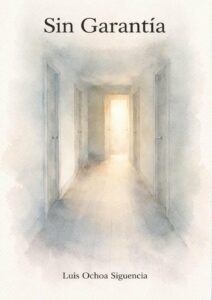
REFLECTIVE NARRATIVE • ETHICS • HUMAN RELATIONSHIPS
Sin Garantía is a reflective literary work exploring care, responsibility and the quiet gestures that sustain everyday life. Rather than offering definitive answers, it invites readers to rediscover the ethical significance of ordinary human relationships and the trust that exists without certainty.
Author: Luis Ochoa Siguencia
Publication: 2026
Genre: Reflective Narrative
Setting: Contemporary World
Availability: Open Access
Licence: CC BY-NC-SA 4.0
Why this Book Was Written
Some books seek to explain the world.
Others invite readers to notice what has always been there, yet has remained almost invisible.
Sin Garantía was written as a philosophical meditation on one of the most fundamental—and least recognised—dimensions of human existence: care.
Throughout modern life, we often admire what is visible: achievements, decisions, productivity and success. Much less attention is given to the quiet acts that make those achievements possible. A meal prepared before dawn, a door opened before someone arrives, a room already warmed, an appointment remembered, a hand that supports without asking to be noticed—these gestures rarely become the subject of history, yet they sustain everyday life.
Luis Ochoa Siguencia conceived this book as a reflection on these invisible structures. Rather than presenting a philosophical argument, he constructs a literary space in which ordinary experiences gradually reveal their ethical depth.
The title, Sin Garantía (“Without Guarantees”), expresses one of the book’s central insights: every act of care involves uncertainty. Those who care for others cannot know whether their efforts will be recognised, remembered or returned. They act without certainty, trusting that what they sustain today may allow another life to flourish tomorrow.
Rather than offering conclusions, the book invites readers to slow down and reconsider the unnoticed foundations upon which families, friendships and communities quietly depend.
The Human World that Inspired the Book
Everyday Life as Philosophy
The world of Sin Garantía is remarkably ordinary.
There are no heroic adventures, mythical landscapes or dramatic historical events.
Instead, readers encounter kitchens, staircases, waiting rooms, apartments, doors, conversations and moments that appear almost insignificant.
Yet it is precisely within these familiar spaces that the book discovers its philosophical richness.
The work suggests that ethical life is rarely constructed through extraordinary decisions. More often, it emerges through repeated gestures that remain almost invisible because they become part of daily routine.
The house therefore becomes more than a physical place.
It becomes a symbol of everything that quietly supports human existence.
The Ethics of Care
One of the book’s deepest inspirations is the recognition that every human life depends upon care received from others.
Long before we become independent, someone prepares our world.
Someone arrives first.
Someone waits.
Someone carries responsibilities we scarcely notice.
Only much later do many people recognise that what once appeared natural was actually the result of countless acts of generosity performed without expectation of reward.
Rather than presenting care as sacrifice alone, Sin Garantía portrays it as one of humanity’s most creative and enduring forms of love.
The Meaning of “Without Guarantees”
Living Without Certainty
The title expresses a universal human condition.
Nothing essential in life comes with guarantees.
Love.
Trust.
Friendship.
Parenthood.
Memory.
Hospitality.
Every meaningful relationship requires an openness to uncertainty.
To care for another person is to accept that gratitude cannot be demanded, outcomes cannot be controlled and recognition may never arrive.
The book therefore proposes an ethics founded not upon certainty but upon generosity.
The Courage to Sustain
Throughout the work, sustaining becomes more important than controlling.
A family survives because someone quietly continues preparing breakfast.
A home remains welcoming because someone notices what others overlook.
Communities endure because invisible responsibilities are accepted before they become emergencies.
The book suggests that civilisation itself depends upon countless anonymous acts of care carried out every day without applause.
Symbols Throughout the Book
The House
The house symbolises more than shelter.
It represents the fragile structure of human relationships.
Walls alone do not create a home.
Homes exist because people continually care for them.
Throughout the book, the house becomes a metaphor for every shared life sustained through quiet responsibility.
The Door
Doors appear repeatedly as symbols of encounter.
Every open door represents welcome.
Every closed door reminds readers that relationships depend upon someone choosing to receive another person.
Crossing a threshold therefore becomes an ethical act rather than merely a physical movement.
The Table
The table symbolises shared existence.
Meals are never simply acts of nourishment.
They are moments in which relationships are renewed through presence, conversation and generosity.
The prepared table also represents invisible labour completed before anyone else arrives.
Light
Light symbolises care that often goes unnoticed.
Like daylight entering a room before anyone awakens, many forms of support remain invisible precisely because they arrive at the right moment.
Only their absence reveals their importance.
Waiting
Waiting becomes an expression of love rather than passivity.
The person who waits offers another the freedom to arrive without pressure.
The book transforms waiting into one of the deepest expressions of hospitality and hope.
Time
Time is never treated as a neutral measurement.
Instead, it becomes the space where relationships are patiently constructed.
Every repeated gesture acquires meaning through continuity rather than intensity.
Silence
Silence occupies a central place throughout the text.
Many of the most important forms of care occur without explanation.
The book reminds readers that not every meaningful action requires words.
Sometimes presence itself becomes the most complete language.
Themes Explored
Care
Care forms the ethical centre of the book.
It is presented not as an exceptional virtue but as the hidden structure supporting ordinary life.
The work encourages readers to recognise care wherever people quietly sustain one another.
Gratitude
Rather than demanding gratitude, the book invites it.
Readers gradually discover how much of their own lives has depended upon gestures they scarcely noticed while they were happening.
Family
Family appears not as an idealised institution but as the first place where human beings learn responsibility, generosity and mutual dependence.
Its importance lies less in biological ties than in the continual decision to remain present for one another.
Responsibility
Responsibility is portrayed as something that grows through attention rather than obligation.
People become responsible not simply because duties exist, but because they learn to notice what another person needs before being asked.
Presence
Again and again, the book suggests that presence cannot be replaced by efficiency.
Being available to another person often matters more than solving their problems.
This quiet philosophy gives the work its remarkable emotional resonance.
Educational Value
Literature for Ethical Reflection
Sin Garantía offers rich opportunities for discussion in higher education, teacher training, philosophy, ethics, psychology and social care.
Teachers, students and reading groups may explore themes such as:
- ethics of care
- philosophical literature
- responsibility
- family relationships
- hospitality
- gratitude
- emotional intelligence
- ageing
- intergenerational dialogue
- symbolic literature
- reflective writing
- contemporary ethics
The book is especially valuable because it encourages reflection rather than instruction.
Instead of presenting moral rules, it invites readers to recognise ethical meaning within their own experiences.
Its short meditative structure also makes it particularly suitable for seminars, reading circles and interdisciplinary discussions connecting literature, philosophy and education.
Reading Experience
Readers approaching Sin Garantía should not expect a conventional narrative.
Instead, they will discover a sequence of interconnected reflections in which ordinary memories gradually reveal unexpected philosophical depth.
The language is quiet, poetic and deliberately unhurried.
Each chapter may be read independently, yet together they construct a unified meditation on care, memory and the invisible foundations of human life.
The book rewards slow reading.
Its meanings continue to unfold long after individual pages have been finished, encouraging readers to reconsider familiar experiences from new ethical perspectives.
Rather than asking dramatic questions, Sin Garantía asks something both simpler and more profound:
Who made your life possible before you realised it?
About the Author
Luis Ochoa Siguencia is a contemporary writer whose literary work combines symbolic fiction, philosophical reflection and cultural humanism. Across his novels, fables and reflective prose, he explores memory, responsibility, identity and the ethical relationships that quietly shape everyday life.
His books invite readers to slow down, observe more carefully and recognise that the deepest human truths are often revealed through ordinary experiences rather than extraordinary events.
Related Works
Readers interested in Sin Garantía may also appreciate other philosophical works by Luis Ochoa Siguencia.
Nothing to Correct explores perfection, vulnerability and the limits of control, complementing Sin Garantía through a shared reflection on the invisible structures that shape contemporary life.
The Hospitality of the World examines hospitality as an ethical encounter, extending many of the themes of welcome, presence and responsibility developed in this book.
The Art of Waiting Without Answers reflects on patience, uncertainty and the quiet transformation that occurs when people learn to inhabit questions without demanding immediate solutions.
Readers interested in symbolic educational literature may also enjoy Aprender caminando, where learning is presented as a lifelong journey shaped by observation, humility and attentive presence.
Together, these works form an interconnected philosophical literary project in which everyday experience becomes a path towards deeper understanding. Rather than offering definitive answers, they encourage readers to recognise that human life is sustained not by guarantees, but by the countless acts of care that quietly precede us and continue long after we cease to notice them.