
Nothing to Correct
Behind the Novel
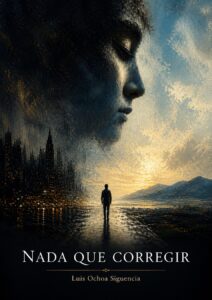
LITERARY NOVEL • PHILOSOPHICAL FICTION • CONTEMPORARY LIFE
Nothing to Correct explores vulnerability, perfection, control and the unexpected beauty of accepting what cannot be corrected. Through quiet encounters and symbolic storytelling, it invites readers to rediscover authenticity in an increasingly optimised world.
Author: Luis Ochoa Siguencia
Publication: 2026
Genre: Literary Novel
Setting: Contemporary World
Availability: Open Access
Licence: CC BY-NC-SA 4.0
Why this Novel Was Written
Some novels begin with extraordinary events. Others begin with ordinary lives that gradually reveal extraordinary questions. Nothing to Correct belongs to the second tradition. It was written as a philosophical exploration of perfection, control and the invisible cost of a life in which everything appears to function flawlessly.
Luis Ochoa Siguencia conceived this novel in response to a contemporary paradox. Modern society celebrates efficiency, productivity and optimisation as signs of success. We organise our time, refine our routines and seek solutions for every inconvenience. Yet the more life is reduced to a sequence of problems to solve, the greater the risk of overlooking the experiences that cannot be measured, controlled or improved.
Rather than presenting dramatic conflict, Nothing to Correct examines the subtle tension between order and authenticity. It asks whether a life without apparent mistakes may also become a life without genuine surprise, vulnerability or transformation.
The novel does not seek to condemn discipline or organisation. Instead, it invites readers to reflect upon a deeper question: can the pursuit of perfection gradually distance us from the very experiences that give life meaning?
Through quiet encounters, symbolic objects and carefully observed moments of everyday life, the narrative explores the fragile boundary between certainty and openness, showing that some of the most important human discoveries begin precisely where control comes to an end.
The Contemporary World that Inspired the Novel
Living in the Age of Optimisation
The world that inspired Nothing to Correct is not defined by war, catastrophe or dramatic historical events. It is the familiar world of modern cities, professional routines, digital communication and carefully organised lives.
Today, technology allows us to schedule every hour, monitor every activity and minimise uncertainty in ways unimaginable only a generation ago. Productivity has become a cultural ideal, while efficiency is frequently mistaken for fulfilment.
The novel reflects upon this reality without rejecting modernity.
Instead, it asks what may be lost when every aspect of life becomes something to optimise.
Can human relationships be organised like calendars?
Can affection be planned?
Can vulnerability be eliminated without also diminishing our capacity for love, empathy and genuine encounter?
These questions form the philosophical landscape of the novel.
The Quiet Solitude of Contemporary Life
Although surrounded by constant communication, many people experience an increasing sense of emotional distance.
Messages arrive instantly.
Schedules remain full.
Conversations become shorter.
Yet genuine presence often becomes more difficult to achieve.
Nothing to Correct explores this subtle form of solitude—not isolation from society, but the gradual disappearance of authentic encounters within an increasingly efficient world.
Its settings, conversations and silences reflect experiences familiar to readers across cultures, making the novel less about a particular place than about the condition of contemporary humanity.
The Meaning of “Nothing to Correct”
Beyond Perfection
The title carries a deliberate paradox.
To say that there is “nothing to correct” appears, at first glance, to suggest completeness.
Yet the novel invites a different interpretation.
Perhaps a life in which nothing requires correction is also a life in which nothing remains open to change.
Human existence is not perfected by eliminating every uncertainty.
It matures through encounters, mistakes, unexpected conversations and moments that resist prediction.
The novel therefore transforms correction from a practical action into a philosophical metaphor.
It asks readers whether constant self-improvement may sometimes become another way of avoiding genuine experience.
Acceptance as Wisdom
Throughout the narrative, acceptance emerges as an alternative to control.
Acceptance is not resignation.
Neither is it passivity.
Rather, it represents the ability to remain present before realities that cannot be solved like technical problems.
The novel suggests that some experiences acquire meaning precisely because they remain unfinished.
Relationships evolve.
People change.
Life rarely offers complete explanations.
Recognising this uncertainty becomes one of the story’s deepest forms of wisdom.
Symbols Throughout the Novel
The Traffic Light
The traffic light represents decision.
It marks the moments when movement pauses and individuals confront choices that cannot always be reduced to logic.
Throughout the novel, these ordinary interruptions become opportunities for unexpected encounters and quiet reflection.
The Garage
The garage symbolises order, security and control.
Everything has its assigned place.
Nothing appears accidental.
Yet this carefully organised space also raises an essential question: can external order compensate for inner uncertainty?
The novel repeatedly invites readers to reflect upon the relationship between physical organisation and emotional life.
The Road
The road symbolises the unfinished nature of human existence.
No journey follows an entirely predictable route.
Every path contains detours, delays and encounters capable of transforming the traveller.
Rather than representing destination alone, the road reminds readers that understanding develops while moving through life rather than after arriving.
Silence
Silence occupies a central place throughout the novel.
It is never simply the absence of speech.
Instead, silence becomes the space where thoughts mature, emotions emerge and genuine understanding begins.
Many of the novel’s most meaningful moments occur not through explanation but through what remains unspoken.
Readers are invited to participate in these silences, discovering their own interpretations rather than receiving definitive answers.
Light
Light symbolises awareness rather than certainty.
Moments of illumination do not eliminate mystery.
Instead, they allow familiar realities to appear from a different perspective.
The novel repeatedly suggests that understanding grows gradually, like daylight, rather than arriving through sudden revelation.
The Mobile Phone
The mobile phone represents connection without presence.
It allows communication across distances while simultaneously reminding readers that information does not necessarily create intimacy.
The novel reflects upon one of the central paradoxes of contemporary life: people have never been more connected, yet meaningful encounters often remain elusive.
The Empty Chair
The empty chair symbolises absence.
It evokes the relationships that shape human existence not only through presence but also through what is missing.
Throughout the narrative, absence becomes a form of memory, encouraging readers to recognise the significance of those who transform our lives, whether or not they remain beside us.
Themes Explored
Perfection and Vulnerability
One of the novel’s central themes is the tension between perfection and vulnerability.
Modern culture frequently encourages individuals to eliminate weakness, uncertainty and error.
The story proposes another possibility.
Perhaps vulnerability is not the opposite of strength but one of its essential conditions.
Without openness to uncertainty, genuine relationships become impossible.
Presence
The novel repeatedly asks what it truly means to be present.
Being physically close to another person is not always the same as truly encountering them.
Presence requires attention, listening and the willingness to allow oneself to be changed by another’s existence.
This quiet ethical insight gives the novel much of its emotional depth.
Identity
Identity emerges throughout the story as something continually evolving.
Rather than presenting identity as fixed or completed, the novel portrays it as an ongoing dialogue between memory, experience and the people we encounter.
Every relationship leaves traces that become part of who we are.
Freedom
Freedom within the novel is not defined simply as unlimited choice.
Instead, it appears as the courage to live without complete certainty.
The ability to accept life’s unpredictability becomes a deeper expression of freedom than the illusion of total control.
Hope
Hope does not arrive through dramatic transformation.
It appears quietly, within ordinary conversations, unexpected gestures and moments of recognition.
The novel celebrates hope as a daily practice rather than an extraordinary event.
Educational Value
Literature for Reflection
Nothing to Correct offers rich opportunities for discussion within universities, reading groups and courses in literature, philosophy, psychology and ethics.
Readers may explore themes including:
- philosophical fiction
- contemporary identity
- perfectionism
- emotional intelligence
- ethics
- vulnerability
- existential questions
- communication
- symbolic literature
- personal growth
- reflective reading
- human relationships
Because the novel avoids simple conclusions, it encourages critical thinking and interpretative dialogue.
Students may compare its symbolic language with philosophical traditions, while book clubs and general readers may discover new perspectives on contemporary life through its subtle narrative.
Its reflective style also makes it particularly suitable for discussions concerning wellbeing, leadership and emotional resilience.
Reading Experience
Readers approaching Nothing to Correct should not expect a conventional psychological thriller or a plot driven by spectacular events.
Instead, they will encounter a contemplative novel where atmosphere, symbolism and quiet observation gradually reveal deeper philosophical questions.
The narrative unfolds with deliberate patience.
Ordinary situations acquire unexpected significance.
Silences become as meaningful as conversations.
Rather than explaining its ideas directly, the novel trusts readers to recognise connections for themselves.
This creates a reading experience that continues long after the final page, inviting reflection rather than closure.
Although deeply rooted in contemporary life, the questions explored throughout the novel are timeless.
What does it mean to live authentically?
Can every problem be solved?
Is perfection always desirable?
What remains when there is, apparently, nothing left to correct?
About the Author
Luis Ochoa Siguencia is a contemporary author whose literary work combines symbolic fiction, philosophical reflection and intercultural dialogue. His novels explore memory, identity, ethics and humanity’s relationship with both cultural and emotional landscapes, transforming everyday experiences into narratives that encourage thoughtful reflection.
Rather than offering definitive answers, his literary project invites readers to engage with universal human questions through stories that value silence, symbolism and the enduring power of imagination.
Related Works
Readers interested in Nothing to Correct may also appreciate other philosophical and symbolic works by Luis Ochoa Siguencia.
The Art of Waiting Without Answers explores uncertainty, patience and the quiet transformation that occurs when human beings learn to live without immediate explanations, complementing many of the existential themes developed in Nothing to Correct.
The Hospitality of the World reflects upon ethics, dialogue and the responsibility of welcoming others, extending the author’s philosophical exploration of presence, empathy and human encounter.
Aprender caminando presents learning as a lifelong journey shaped by observation and openness, demonstrating that genuine understanding often begins when certainty gives way to curiosity.
Readers interested in the symbolic relationship between memory, identity and cultural heritage may also enjoy Carachula: The Lost Civilisation of the Cañaris, where archaeology, history and philosophical reflection come together in an exploration of what civilisations choose to remember.
Together, these works form an interconnected literary project in which philosophy, symbolism and narrative converge. Although each novel stands independently, all invite readers to slow down, question familiar assumptions and recognise that the deepest transformations often begin not through extraordinary events, but through the quiet rediscovery of what it means to be fully human.