
El arte de esperar sin respuesta
Behind the Novel
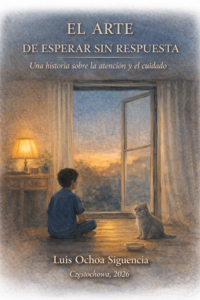
REFLECTIVE NARRATIVE • ATTENTION • CHILDHOOD
A quiet literary meditation on patience, attention and friendship, El arte de esperar sin respuesta explores how waiting without immediate answers can become a path towards understanding, resilience and personal growth.
Author: Luis Ochoa Siguencia
Publication: 2026
Genre: Reflective Narrative
Setting: Universal
Availability: Open Access
Licence: CC BY-NC-SA 4.0
Why this Story Was Written
Some of life’s most profound transformations do not begin with certainty. They begin with waiting.
The Art of Waiting Without Answers was written as a literary meditation on one of the least celebrated yet most universal human experiences: living with uncertainty. Rather than presenting waiting as a passive interval between events, the novel explores it as an active process through which identity, wisdom and emotional resilience gradually emerge.
Luis Ochoa Siguencia conceived this work as part of his wider symbolic literary project, where narrative becomes a space for philosophical reflection rather than the delivery of simple conclusions. The novel asks whether understanding always arrives through explanation—or whether some truths reveal themselves only after we learn to inhabit uncertainty without fear.
In an age increasingly driven by immediate answers and constant acceleration, the story proposes an alternative rhythm. It invites readers to rediscover patience, contemplation and the quiet transformation that often occurs long before external circumstances change.
Rather than offering solutions, the novel creates a literary space where questions themselves become meaningful.
The Human Landscape Behind the Novel
Waiting as a Universal Experience
Every culture has developed stories about journeys, beginnings and endings.
Far fewer narratives explore the space between them.
The period of waiting—between loss and healing, childhood and adulthood, certainty and understanding—is often where the deepest human growth occurs. Yet modern society frequently treats waiting as an obstacle to overcome rather than a meaningful part of life.
This novel reverses that perspective.
Waiting becomes a landscape in its own right, inviting readers to reflect upon how time reshapes perception, relationships and identity.
The story belongs to a tradition of contemplative literature that values silence as much as action and inner transformation as much as external events.
A Literary Reflection Rather Than a Philosophical Treatise
Although inspired by philosophical questions, The Art of Waiting Without Answers remains a work of literary fiction.
Its ideas emerge through symbols, atmosphere and emotional experience rather than abstract argument.
Readers are encouraged to interpret its images according to their own experiences, allowing the novel to remain open rather than prescriptive.
In this sense, it follows the tradition of symbolic literature, where meaning grows through reflection rather than explanation.
The Meaning of Waiting
Beyond Patience
Waiting is often confused with passivity.
The novel proposes something different.
Authentic waiting requires attention, courage and acceptance. It demands the willingness to remain present even when certainty is unavailable.
Rather than delaying life, waiting becomes part of living itself.
Many of the most important human experiences—love, grief, forgiveness, creativity and hope—cannot be forced to unfold according to our preferred timetable.
The novel explores this reality through symbolic narrative rather than direct instruction.
Living Without Immediate Certainty
Modern culture often values answers more than questions.
The story gently challenges this assumption.
Some questions accompany us throughout life not because they lack answers, but because they continue shaping who we become.
Learning to live alongside uncertainty may therefore represent a form of wisdom rather than limitation.
Symbols Throughout the Novel
The Path
The path symbolises life’s continuous movement despite incomplete understanding.
One rarely sees the entire journey.
Instead, each step reveals only enough for the next.
The path reminds readers that progress often depends more upon trust than certainty.
Silence
Silence occupies a central place throughout the novel.
It is never presented as emptiness.
Instead, silence becomes the environment where thoughts mature, emotions settle and deeper understanding quietly develops.
Many philosophical and spiritual traditions recognise silence as an essential companion to wisdom.
The novel embraces this timeless idea.
Time
Time appears not as an enemy but as a collaborator.
Rather than simply passing, time transforms perception.
Experiences that once seemed meaningless gradually acquire significance when viewed from a different distance.
The novel therefore encourages readers to consider time as an active participant in personal growth.
Light
Light symbolises moments of recognition rather than complete certainty.
Understanding arrives gradually.
Illumination does not eliminate mystery; it simply allows readers to perceive familiar realities from a new perspective.
The Horizon
Throughout literature, the horizon frequently represents possibility.
Here it also symbolises acceptance.
No matter how far we travel, some horizons continue moving ahead of us.
The novel suggests that fulfilment comes not from reaching every horizon, but from learning to walk peacefully towards them.
Memory
Memory functions as an evolving conversation between past and present.
The novel explores how remembered experiences continually change meaning as individuals mature.
Rather than preserving the past unchanged, memory becomes a living process of reinterpretation.
Themes Explored
Hope
Hope is presented neither as optimism nor certainty.
Instead, it becomes the quiet decision to continue moving despite incomplete knowledge of what lies ahead.
This restrained understanding of hope gives the novel emotional depth while avoiding sentimentality.
Identity
Identity develops through experiences that rarely provide immediate clarity.
Waiting itself contributes to personal formation.
The novel therefore portrays identity as something continuously unfolding rather than permanently established.
Emotional Resilience
Resilience is often misunderstood as emotional strength alone.
The narrative suggests that resilience also includes vulnerability, patience and the ability to remain open even when answers remain absent.
This perspective reflects contemporary psychological understanding while remaining grounded in timeless literary symbolism.
The Search for Meaning
Meaning does not always arrive through dramatic revelation.
Sometimes it emerges quietly through repeated acts of attention, compassion and reflection.
The novel invites readers to recognise these quieter forms of transformation.
Educational Value
Literature for Reflection
The Art of Waiting Without Answers offers valuable opportunities for discussion in educational, philosophical and literary contexts.
Teachers, students, book clubs and reflective reading groups may use the novel to explore themes including:
- emotional resilience
- philosophical reflection
- symbolic literature
- ethics
- uncertainty and decision-making
- personal identity
- hope and perseverance
- emotional intelligence
- contemplative reading
- cultural interpretations of time
- mental wellbeing through literature
Rather than presenting fixed conclusions, the novel encourages interpretative dialogue.
Readers are invited to compare their own experiences with the symbolic journey presented throughout the narrative.
Reading Experience
Readers approaching The Art of Waiting Without Answers should expect a contemplative literary experience.
The novel unfolds gradually, rewarding attentive rather than hurried reading.
Its narrative rhythm reflects the emotional experience of waiting itself.
Moments of quiet observation often carry greater significance than dramatic events, allowing reflection to become part of the reading process.
Those interested in philosophical fiction, symbolic literature, contemporary reflective novels and emotionally intelligent storytelling may discover a narrative that remains with them long after the final page.
Rather than answering every question, the novel encourages readers to become more comfortable asking meaningful ones.
About the Author
Luis Ochoa Siguencia is a contemporary author whose symbolic literary works explore memory, identity, ethics and humanity’s relationship with both cultural and inner landscapes. Drawing inspiration from philosophy, intercultural dialogue and poetic narrative, his fiction seeks to create spaces for reflection rather than certainty.
Across his literary project, he combines symbolic storytelling with educational values, encouraging readers of different ages and cultural backgrounds to engage thoughtfully with universal human experiences.
Related Works
Readers interested in The Art of Waiting Without Answers may also appreciate other contemplative works by Luis Ochoa Siguencia.
Aprender caminando explores learning as a gradual journey of observation and self-discovery inspired by the educational traditions of the Andes.
Aman-Yupanqui, El Niño del Pacto reflects upon responsibility, cultural memory and ancestral inheritance through symbolic fiction rooted in the Andean worldview.
La hospitalidad del mundo examines the ethics of welcome, human dignity and responsibility towards others, extending the author’s exploration of philosophical themes into the realm of hospitality and encounter.
For readers drawn to symbolic narratives inspired by cultural heritage, Carachula: The Lost Civilization of the Cañaris offers a broader meditation on memory, history and identity through the mysterious landscapes of southern Ecuador.
Together, these works form an interconnected literary universe in which each novel approaches a different dimension of the human experience. Rather than sharing characters or chronological continuity, they are united by a common commitment to symbolic fiction, reflective reading and the enduring search for meaning.